
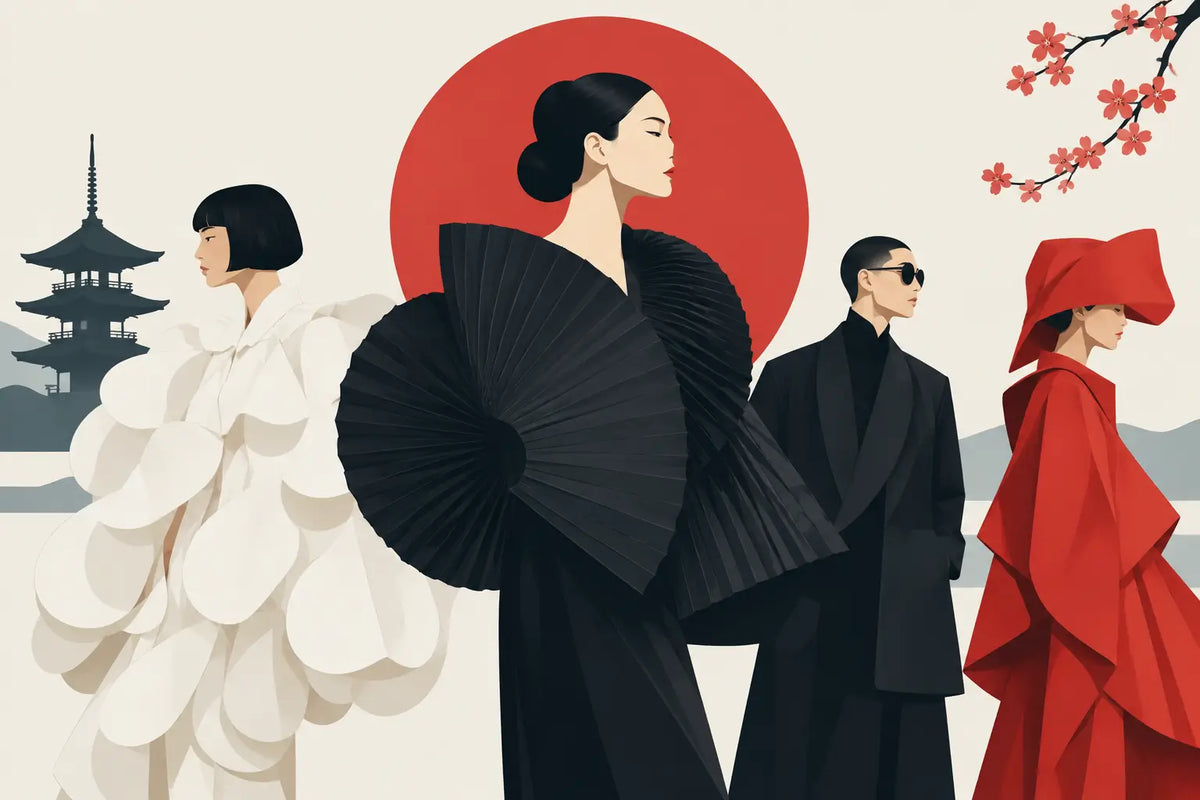
Japanese Avant Garde Fashion Designers Who Changed Dress
A Comme des Garçons jacket can make the body feel provisional. A Yohji Yamamoto coat can give it gravity. An Issey Miyake pleat can alter with every movement. Japanese avant garde fashion designers did not simply introduce new clothes to the international market. They changed the terms by which clothing could be understood: as architecture, interruption, memory, concealment, or a private system of rules.
For collectors, the appeal is not novelty alone. It is the rigor behind the apparent disorder. The most consequential Japanese work remains recognizable because a silhouette, textile treatment, or construction method carries an internal logic. It asks to be lived with, not merely seen.
Why Japanese Avant Garde Fashion Designers Still Matter
When Rei Kawakubo and Yohji Yamamoto arrived in Paris in the early 1980s, their work was frequently described through absence: black, holes, asymmetry, unfinished edges, clothes that appeared to reject conventional ideas of flattery. That language missed the point. Their collections were not anti-fashion. They were fashion practiced with a more demanding vocabulary.
Kawakubo made volume, rupture, and refusal into design tools. Her garments could place padding where anatomy did not expect it, turn a sleeve into a question, or let a dress resist a clean reading from every angle. Comme des Garçons established that beauty need not be smooth, balanced, or immediately reassuring.
Yamamoto approached the body differently. His tailoring has weight, space, and a particular relationship to time. A black wool coat may be cut with an ease that seems casual until it moves. A jacket can borrow from menswear without becoming costume. The work often feels protective, but never inert. It gives the wearer room to decide who they are inside it.
This distinction matters in a market crowded with surface-level deconstruction. A distressed seam is not automatically radical. In the strongest Japanese avant-garde work, the material, cut, and concept are inseparable. What looks imperfect has been considered from every side.
The body became a site of inquiry
The Western luxury system long relied on a stable proposition: clothing should refine the body, signal status, and resolve into a desirable outline. Japanese designers frequently made the outline unstable. They shifted attention from the idealized figure to movement, proportion, concealment, and negative space.
That shift has enduring consequences. Oversized tailoring, exposed construction, collapsed knits, technical hybrids, and deliberately awkward volume have all become familiar fashion language. Yet the source work remains more difficult than its descendants. It rarely offers an easy visual reward. It asks the wearer to accept proportion before seeking approval.
The Houses That Expanded the Vocabulary
Comme des Garçons is central, but it is not a single aesthetic. Rei Kawakubo’s main line, Homme Plus, Tricot, and the many projects around the house each hold distinct histories. The collector’s task is to identify the particular proposition of a season rather than treat the label as a uniform category. A sculptural jacket from a runway known for bodily distortion belongs to a different conversation than an early black wool piece or a graphic knit from a later collection.
Junya Watanabe, who developed within the Comme des Garçons universe, is another essential study in precision. His work often begins with a garment category - the denim jacket, the trench, the dress, the down coat - and subjects it to structural revision. Patchwork, technical fabrication, and modular construction can appear practical at first glance. Look closer, and the pattern work reveals a controlled complexity. Junya’s best pieces reward handling as much as viewing.
Yohji Yamamoto and Y’s remain touchstones for those drawn to drape, shadow, and exacting tailoring. The value is often in restraint. Dense wool, washed cotton, rayon, and linen acquire presence through cut rather than embellishment. A Yamamoto piece may reveal its intelligence only after wear: the angle of a pocket, the fall of a lapel, the unexpected balance of a long hem.
Issey Miyake expanded the field through material research. Pleats Please made engineered pleating part of daily dress, while earlier collections and A-POC experiments considered clothing as a system that could be produced, worn, and transformed with remarkable economy. Miyake’s work is often accessible in spirit, but it should not be mistaken for simple. Its lightness rests on technical discipline.
Undercover brought a different charge. Jun Takahashi fused punk, youth culture, graphic imagery, and precise tailoring without reducing any of them to reference. Certain 1990s and early 2000s pieces now hold particular archival force because they capture a moment when subculture, Japanese streetwear, and conceptual fashion were in active collision. Condition, original graphic integrity, and collection context are especially relevant here.
Reading Japanese Avant-Garde Fashion in the Archive
An archive garment should be read first as an object. Begin with fabrication. Is the wool dense or airy? Is the nylon meant to retain creases? Does a faded black cotton read as damage, or as part of the intended finish? Japanese design often makes texture carry as much meaning as silhouette.
Then examine construction. Interior seams, panel placement, closures, lining, and the relationship between front and back can reveal more than a label. A garment with an unconventional shape may be surprisingly engineered, while a seemingly plain coat may contain its argument in a subtle offset closure or an unorthodox shoulder.
Provenance gives that observation context. Season, line, period, country of manufacture, and any relation to a documented runway can affect collector interest, but they do not replace discernment. Not every rare piece is a great piece, and not every important garment needs a dramatic provenance to deserve a place in a wardrobe.
Condition requires a clear-eyed standard. Fading, irregular dye, raw edges, and deliberate fraying may be integral to the design. Moth damage, compromised fabric, missing hardware, and unstable seams are different matters. For wearable collecting, there is always a trade-off between historical purity and practical life. A pristine early piece may be best preserved; a later or more resilient example may be the one that becomes part of a personal uniform.
Fit also resists conventional assumptions. Many Japanese garments were conceived around air, layering, or a moving body rather than a fixed size chart. Measurements matter, but so does trying the garment on. The difference between an intentional oversized silhouette and a simply oversized garment becomes clear in the shoulder, sleeve, and balance of the hem.
Now, Then, and the Problem With Trend Language
Calling these designers influential is accurate, but incomplete. Influence can flatten a body of work into a set of familiar cues: black clothing, asymmetry, oversized shapes, visible seams. Once those cues become trends, the thinking behind them is easily lost.
The more useful distinction is between Now and Then. Current collections show how a house continues to revise its language under present conditions. Archive pieces reveal earlier moments of risk, including ideas that were never designed to be repeated. Neither is automatically superior. A current-season Yohji piece may offer the most immediate expression of his ongoing practice; an archive Comme des Garçons garment may preserve a proposition that only existed for one season.
For a collector, the strongest wardrobe moves between the two. It places a historical garment beside a current piece without forcing either into nostalgia. At Anastasia Boutique, this is the value of holding contemporary work and archive in the same field: not a chronology lesson, but a sharper way of seeing.
What makes a piece worth keeping
The best acquisition is not always the loudest runway artifact. It may be a coat whose cut changes the way you stand, a skirt that makes layering newly possible, or a knit that carries a specific era without becoming costume. Rarity has meaning when it meets design integrity and personal conviction.
Japanese avant-garde fashion rewards patience. Spend time with the garment in motion. Look at its reverse side. Notice what it refuses to make easy. The right piece does not need to announce its importance. It alters the terms of the wardrobe around it.

Leave a comment
This site is protected by hCaptcha and the hCaptcha Privacy Policy and Terms of Service apply.