
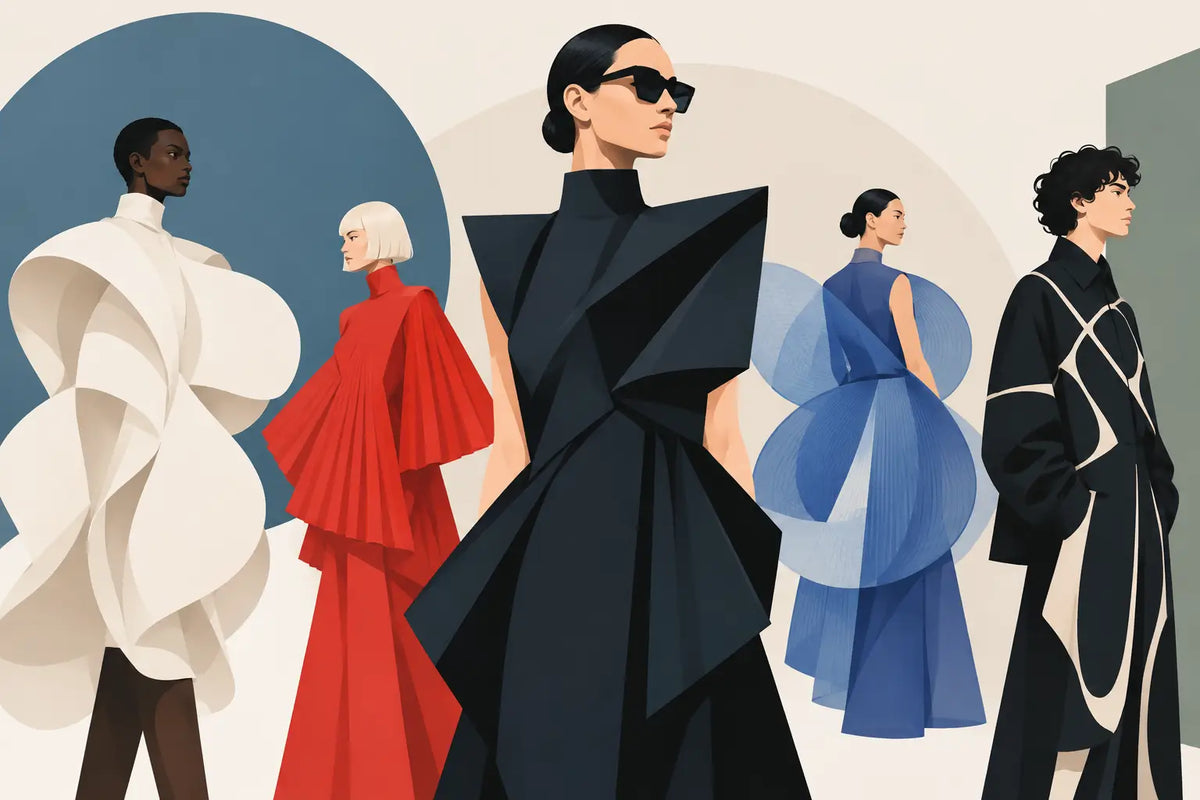
Avant Garde Fashion Designers List: 12 to Know
A useful avant garde fashion designers list does more than name the familiar houses. It reveals distinct design languages: the garment turned inside out, the body redrawn, tailoring made unstable, utility made poetic. These are designers whose work resists easy seasonal reading and rewards close attention to fabrication, proportion, reference, and provenance.
Avant-garde fashion is not a single silhouette or a synonym for black clothing. Its most enduring practitioners often disagree with one another completely. What joins them is a willingness to question the expected function of a jacket, a dress, a shoe, or even a fashion image itself. For collectors, that is where the lasting charge begins.
Avant Garde Fashion Designers List: 12 Essential Voices
1. Maison Martin Margiela
Martin Margiela changed the terms of late-20th-century fashion. His work treated clothing as evidence: linings exposed, hems left unfinished, repurposed materials elevated, proportions deliberately displaced. The anonymous white label and the numbered artisanal line were not branding gestures alone. They framed a new way of seeing authorship, labor, and the life of a garment.
Early pieces from the 1990s and 2000s remain especially resonant because their ideas are inseparable from their construction. A reconstructed leather jacket, a stockman-inspired bodice, or a deconstructed knit can carry more force than a logo ever could.
2. Rei Kawakubo for Comme des Garçons
Rei Kawakubo has spent decades making fashion strange in the most rigorous sense. Comme des Garçons collections can be sculptural, confrontational, romantic, awkward, or all four at once. The body is often interrupted rather than flattered, with padding, voids, compressed volumes, and improbable shapes creating a silhouette that asks the viewer to reconsider what beauty permits.
Comme des Garçons is particularly significant for collectors because the house’s radical runway vocabulary often appears in wearable fragments: an asymmetric wool coat, a densely treated jacket, a distorted cardigan. The more challenging pieces demand context. The quieter ones often reveal Kawakubo’s discipline just as clearly.
3. Yohji Yamamoto
Yohji Yamamoto’s black is never merely black. It carries drape, density, shadow, and movement. His tailoring loosens the architecture of conventional suiting without abandoning its intelligence, producing coats and jackets that feel both severe and deeply human.
Yamamoto’s work rewards wear. The best pieces acquire presence through motion and time, rather than through a fixed, photographic perfection. For those building a wardrobe rather than a display, his designs offer one of avant-garde fashion’s most livable worlds.
4. Rick Owens
Rick Owens fused California athleticism, underground glamour, and monumental classicism into a language immediately his own. His elongated jerseys, leather jackets, platform boots, and architectural outerwear operate with unusual consistency across decades. A Rick Owens silhouette can be spare, but it is rarely neutral.
The trade-off is scale. His proportions are intentional and often dramatic, so fit matters beyond the tagged size. A cropped leather jacket, a long knit, or a sharply shouldered coat should be assessed as part of a complete line, not as an isolated basic.
5. Junya Watanabe
Junya Watanabe works through engineering. His collections are known for complex pattern cutting, hybrid garments, technical textiles, and collaborations that transform familiar categories. A blazer may unfold into a lattice; a trench may become a study in panels, pleats, and utility.
His work is often described as cerebral, but the better word may be precise. Watanabe designs for the wearer who notices construction first. Archive pieces can be deceptively simple on the hanger and astonishing once worn.
6. Ann Demeulemeester
Ann Demeulemeester brought a literary, nocturnal sensibility to the Antwerp school. Her clothing balances masculinity and fragility through elongated tailoring, narrow trousers, distressed knits, feathered details, and a signature tension between restraint and romanticism.
Unlike designers whose disruption is overtly sculptural, Demeulemeester often works through atmosphere. Her strongest garments are not costumes. They create a private visual language for the wearer, particularly when layered with care.
7. Jean Paul Gaultier
Jean Paul Gaultier understood fashion as performance, social commentary, and technical spectacle. Corsetry, trompe l’oeil prints, tattoo imagery, sailor references, mesh, and gender play appear throughout his vast body of work. Yet the provocation is supported by exceptional dressmaking.
For archive buyers, the distinction between runway impact and collectible value matters. Not every printed piece carries equal significance. Look for era-specific fabrication, documented motifs, unusual construction, and garments that reflect Gaultier’s ability to make cultural references feel newly volatile.
8. Issey Miyake
Issey Miyake approached the body through material innovation. Pleating, folding, compression, and modular construction allowed his garments to move from flat form into volume with remarkable economy. The result can feel futuristic even when the piece is decades old.
Miyake’s importance lies partly in his refusal to separate experimentation from ease. Many designs travel well, move freely, and adapt to the body. That practicality does not lessen their conceptual force. It is central to it.
9. Undercover
Jun Takahashi’s Undercover is built on collision: punk and classicism, adolescent unease and refined tailoring, graphic intensity and carefully realized clothing. The label’s references can be explicit, but its emotional register is more elusive - melancholy, rebellious, and often beautifully off-balance.
Collectors tend to seek particular seasons, graphics, and collaborations, yet a quieter Undercover coat or knit can be equally persuasive. The house is strongest when its subcultural sources are translated rather than simply quoted.
10. Hussein Chalayan
Hussein Chalayan made garments behave like objects, architecture, and propositions. His most recognized works include dresses that transform, furniture that becomes clothing, and collections shaped by migration, memory, displacement, and technology.
Chalayan’s rarer pieces often require careful condition review because their mechanisms and materials can be integral to the design. When complete and well preserved, they belong as much to design history as to a conventional wardrobe.
11. Walter Van Beirendonck
Walter Van Beirendonck works in saturated color, exaggerated graphics, and sharp conceptual messaging. His clothing is playful, political, and deliberately excessive, with references that move between club culture, surrealism, sexuality, and futurism.
He offers a necessary correction to the idea that avant-garde fashion must be austere. His work proves that intellectual fashion can be loud, funny, and visually direct without losing rigor.
12. Craig Green
Craig Green has developed a contemporary vocabulary around uniform, protection, ritual, and vulnerability. His padded structures, tied panels, harness-like details, and workwear references give his collections the gravity of objects made for an unknown ceremony.
As a newer archive, Green’s work requires a different lens than a 1990s Margiela piece. Scarcity alone is not enough. The pieces most likely to endure are those where the central idea, material, and silhouette are inseparable.
How to Read an Avant-Garde Garment
The most valuable question is not, “Is this recognizable?” It is, “What does this piece do that another garment cannot?” Sometimes the answer is technical: a pattern cut that changes how a coat hangs, a textile developed for a single collection, a construction method that turns a flat object into volume. Sometimes it is cultural: a silhouette that defined a period, a print tied to a specific runway moment, a garment that changed how fashion understood gender or utility.
Condition, size, and documentation affect collector value, but they should not eclipse design. A pristine piece with little conceptual distinction may be less compelling than a carefully repaired garment with direct historical relevance. Conversely, certain fragile or performance-oriented works are best acquired as objects of study rather than daily wear. It depends on whether the piece is entering a wardrobe, an archive, or both.
At Anastasia Boutique, the distinction between Now and Then makes room for both impulses. Current-season design can sharpen an existing wardrobe; archive can give it a deeper timeline. The right piece need not announce its rarity. It should alter the way everything around it is seen.
Choose the designer whose questions remain alive in your own life, then spend time with the garment in person when possible. The shoulder line, the weight of the cloth, the interior finish, and the way it moves will tell you what an image cannot.

Leave a comment
This site is protected by hCaptcha and the hCaptcha Privacy Policy and Terms of Service apply.