
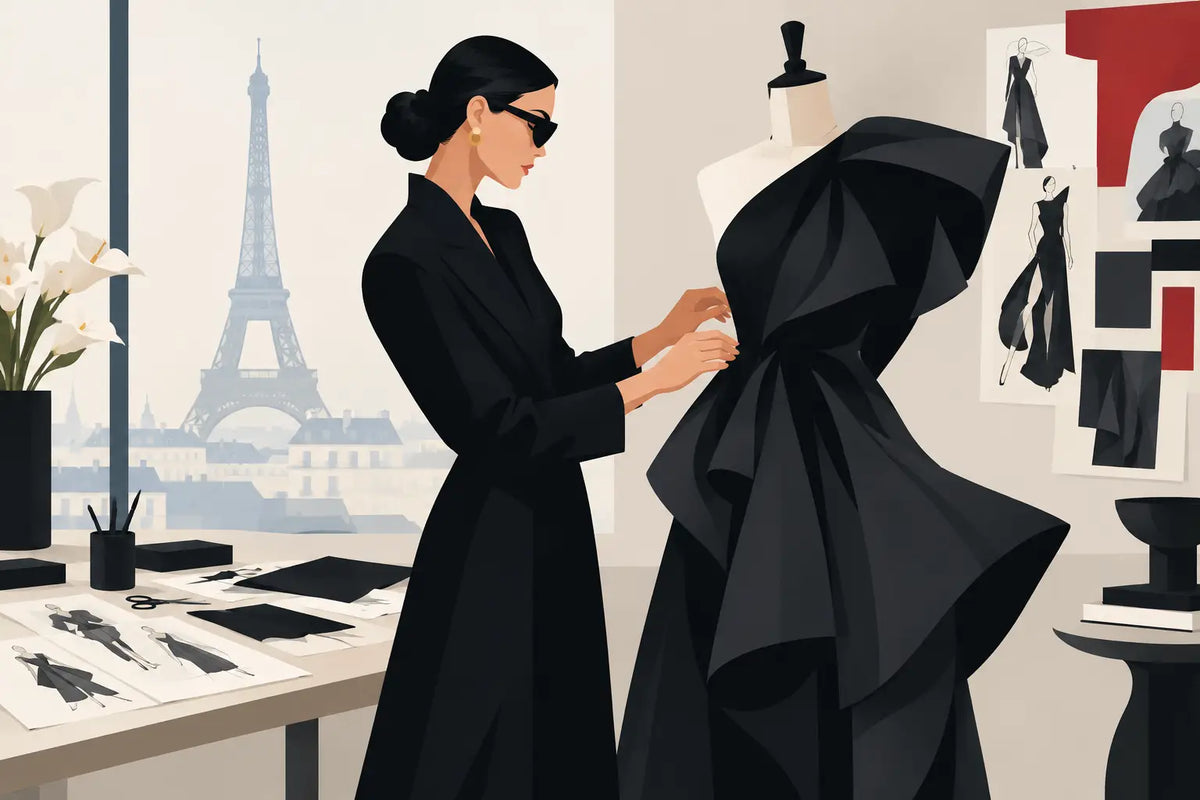
What Makes a French Avant Garde Fashion Designer?
A French avant garde fashion designer does not simply propose a new look. They alter the terms by which clothing is understood: where a shoulder belongs, how a body moves through a garment, whether luxury needs polish, and what remains when decoration is stripped away. The most consequential work often feels slightly unresolved at first. That tension is the point.
For collectors, stylists, and those who dress with intention, French avant-garde fashion is less a fixed aesthetic than a way of reading clothes. A garment may be severe or theatrical, impeccably tailored or visibly unfinished. Its value lies in the intelligence of its construction, the clarity of its proposition, and the place it holds in a larger design history.
French Avant-Garde Fashion Is a Parisian Language
The phrase is more complicated than it appears. Not every important designer working in the French avant-garde is French by nationality, and not every French designer belongs to the avant-garde. Paris has long been a site where international designers test ideas against couture technique, industrial production, fashion press, and an unusually demanding audience.
Martin Margiela, for example, is Belgian, yet his work is inseparable from the Paris fashion system he disrupted. Rei Kawakubo is Japanese; Yohji Yamamoto is Japanese; Rick Owens is American. Their Paris presentations, however, helped define how late 20th- and early 21st-century fashion understood radical silhouette, intellectual dressing, and authorship. To call all of this simply French misses the point. To ignore Paris would also be inaccurate.
The more useful distinction is this: French avant-garde fashion is a lineage of ideas shaped in and around Paris. It prizes the conceptual gesture without abandoning the garment. The best pieces remain wearable, but they ask the wearer to participate.
The Garment Comes Before the Image
Mainstream luxury often begins with recognition. A logo, a signature bag, a familiar seasonal silhouette. Avant-garde design begins elsewhere: with a cut, a material, a method, or a question.
A Jean Paul Gaultier mesh top can turn the body into a printed surface. A Maison Martin Margiela jacket can expose lining, basting, and the normally hidden labor of tailoring. André Courrèges made the future feel clean, athletic, and engineered through sharp geometry and technical fabrication. These are distinct visual worlds, but each treats clothing as an argument rather than an accessory.
That is why a compelling piece may appear quiet on a hanger. Its significance can sit in a curved seam, an offset closure, a deliberately raw edge, a transformed vintage textile, or a proportion that changes only when worn. Photography can suggest the mood. Construction proves the idea.
For a collector, this changes the first question. Instead of asking whether a garment is recognizable, ask what it does. Does it shift the line of the body? Does it make familiar material behave differently? Is the apparent imperfection intentional and structurally resolved? A French avant-garde fashion designer earns attention through decisions that withstand close looking.
Deconstruction Is Not Neglect
Deconstruction is often reduced to fraying, exposed seams, and an unfinished appearance. That reading is too superficial. In its strongest form, deconstruction reveals how fashion creates authority in the first place.
Margiela's work made linings, labels, stockman forms, replica garments, and the anonymous white coat part of the visual vocabulary. The result was not carelessness. It was a precise reconsideration of what viewers are taught to value. A jacket turned inside out can be more technically exacting than one that presents a conventional finish.
Condition matters, especially in archive. But the distinction between intended distress and actual damage is essential. Fading may be integral to a garment's original concept; a weakened silk panel, broken zipper, or compromised stretch mesh is a condition issue. Provenance and inspection protect both the wearer and the work.
From Couture Rebellion to Archive Object
French fashion has always contained its own opposition. Elsa Schiaparelli brought surrealism into dress, treating a shoe, a skeleton, or a trompe l'oeil bow as an intellectual provocation. Pierre Cardin pursued geometric futurism and expanded fashion into new systems of licensing and production. Courrèges recast modernity in white vinyl, wool, and exact line.
By the 1980s and 1990s, the conversation became more fractured and more self-aware. Fashion questioned gender, beauty, commercial desire, celebrity, and the very notion of originality. Gaultier placed underwear on the outside, collaborated across subcultures, and made hybridity central to his vocabulary. Margiela approached the existing wardrobe as raw material, fragmenting and rebuilding its codes.
These decades matter because they produced garments that now read differently outside their original runway moment. A 1990s piece can retain its visual force while gaining another layer of significance: it becomes evidence of a particular fashion argument, made before the argument had become a market category.
Archive collecting is not nostalgia. It is the practice of locating a garment within its era, collection, fabrication, and design lineage. A piece from an influential season may be scarce, but scarcity alone does not make it consequential. The more lasting question is whether the garment captures a designer's language with unusual precision.
How to Read a Piece Before You Buy It
The most rewarding purchases are usually not the loudest ones. They are the pieces whose intelligence becomes clearer with wear. Start with silhouette. Look at where volume is placed and how the garment behaves from the side and back, not only from the front.
Then consider fabrication. Is the textile integral to the design, or merely decorative? Latex, mesh, coated cotton, bonded wool, technical nylon, aged leather, and hand-worked knitwear all carry different demands. Some materials are meant to change over time. Others require careful storage and limited wear. A collectible garment should fit a real life, even if that life is occasional.
Examine internal details as carefully as external ones. Labels, closures, seam finishes, alterations, and care tags can establish period and authenticity, while also revealing how a piece was made. With older garments, ask whether alterations respect the original proportion. A hem can be restored; a radically narrowed sleeve or removed structural panel may change the designer's intention.
Finally, resist the urge to buy an archive piece simply because it is rare. Rarity without personal resonance becomes storage. The right garment has presence, but it also has a future with you. It can enter a wardrobe without becoming ordinary.
Now and Then Belong in the Same Wardrobe
There is no need to choose between current avant-garde design and historical pieces. The relationship between them can be particularly rich. A current season coat may sharpen the shape of a 1990s Gaultier mesh layer. A precise black trouser can make an archival Margiela top feel less like costume and more like a continuing idea.
The trade-off is practical. Archive often offers singularity, but sizing can be limited and materials may require patience. Current collections offer more consistency, replacement options, and garments designed for present-day wear. Neither is inherently superior. It depends on whether the priority is historical specificity, daily utility, or the rare occasion when both meet.
At Anastasia Boutique, the distinction is held as two connected worlds: Now for present collections and Then for garments with a past. The most exceptional one-of-one pieces ask for a different kind of encounter. They are best seen in person, where weight, condition, scale, and feeling can be understood without mediation.
Wear the Question
The lasting power of a French avant-garde garment is not that it refuses convention for its own sake. It gives the wearer another way to inhabit convention: to sharpen it, undo it, turn it inside out, or leave it behind for the evening.
Choose the piece that continues to reveal itself after the first impression. The one that makes getting dressed feel less like completion and more like a considered question.


Leave a comment
This site is protected by hCaptcha and the hCaptcha Privacy Policy and Terms of Service apply.