
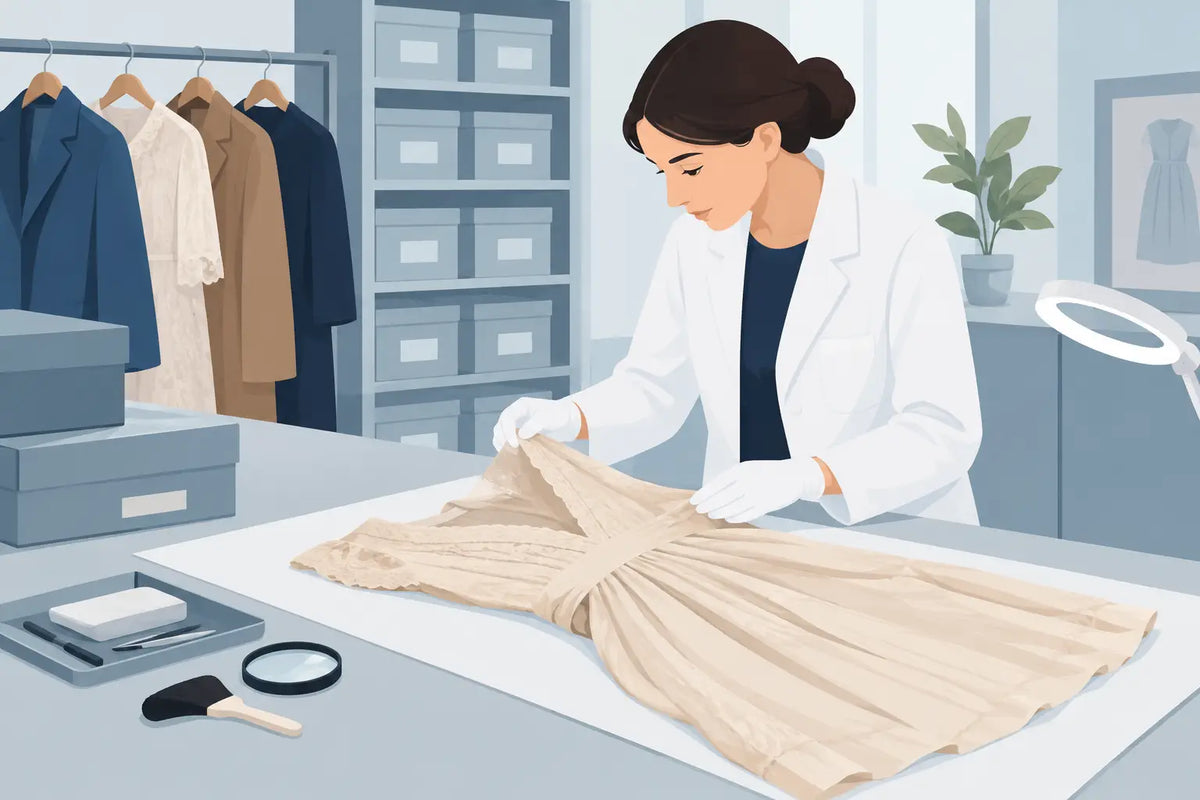
Garment Condition Assessment for the Archive
A garment condition assessment is not a search for perfection. It is a close reading of evidence: the softened edge of a cuff, a missing sequin, the integrity of a bonded seam, the particular way silk has held its color. For archival fashion, condition informs value, wearability, and the garment’s relationship to its own history.
A 1990s Margiela knit and a current-season Rick Owens leather jacket should not be judged by the same expectations. One may carry decades of material change; the other should arrive with the precision of its original construction intact. The useful question is never simply, “Is it damaged?” It is, “What has changed, why, and does that change alter the piece?”
What Garment Condition Assessment Actually Measures
Condition is often reduced to a short label: excellent, very good, good. Those terms are useful only when they are supported by specifics. A serious assessment considers material, construction, finish, previous ownership, and the intended use of the garment. It separates honest age from avoidable deterioration.
A Yohji Yamamoto wool coat may show a slight surface bloom after years of careful wear. That can be consistent with its fiber and its life as clothing. A polyurethane panel from the early 2000s, by contrast, may crack or become tacky because the material has a finite life span, even when it has been stored attentively. Neither observation is cosmetic. Each changes how the piece can be worn, preserved, insured, or collected.
Condition also exists beside authenticity, rather than replacing it. Correct labels, fabrication, season references, and provenance establish what a garment is. Assessment establishes what remains of it now.
Read the Garment in Its Original Language
Avant-garde garments often refuse ordinary standards of finish. Raw hems, asymmetry, exposed seams, intentional abrasion, distressed leather, oxidized hardware, and irregular dye are frequently part of the design. Treating these choices as defects erases the garment’s language.
This is where familiarity with the designer matters. A deliberately unfinished Comme des Garçons edge is not equivalent to a frayed hem caused by abrasion. A Junya Watanabe reconstruction may contain irregular panels and visible joins by design. A Jean Paul Gaultier mesh may be meant to sit close to the body with a degree of transparency that makes minor pulls immediately visible. Context determines whether an irregularity belongs to the original expression or developed afterward.
Photographs help, but they do not settle every question. Texture, elasticity, odor, weight, and the sound of a fabric when handled can reveal conditions a camera cannot. A dry leather surface may appear sound until it flexes. A silk lining can look clean while weakened along the armhole. For one-of-one garments, an in-person viewing is often the clearest form of due diligence.
Material Changes Are Not All Equal
Natural fibers tend to age in legible ways. Wool can pill, felt, or thin at friction points. Cotton can fade, soften, and develop small breaks near seams. Silk may lose strength through light exposure or perspiration, particularly at the neckline, underarms, and waist. Leather can dry, darken, stiffen, or take on a rich patina depending on its finish and storage.
Synthetic and composite materials require a different level of caution. Stretch fibers can lose recovery. Foam can deteriorate. Laminated surfaces can delaminate. Rubberized coatings, plastic embellishments, and polyurethane garments may break down without obvious misuse. These processes are sometimes irreversible, and they are not always predictable from appearance alone.
That does not make a materially fragile piece less significant. It does mean ownership becomes more specific. A collector may accept a compromised early synthetic garment because its design, rarity, or provenance outweighs its limitations. A stylist borrowing for an editorial may make a different decision. The condition report should make that trade-off visible, not make it on the buyer’s behalf.
The Areas That Merit Close Attention
Most garments tell their story at points of stress. Inspect the underarms, collar, cuffs, hems, pockets, closures, and lining before giving disproportionate attention to a small mark on the exterior. These are the places where wear, strain, alteration, and prior repair often appear.
With tailoring, look at shoulder structure, sleeve pitch, canvas, and the hang of the hem. A jacket may be visually clean but altered so extensively that its original proportion has changed. With draped or bias-cut pieces, examine whether the garment rests as intended on a body or hanger. Stretching can alter the line of a dress without producing a single visible tear.
Hardware deserves its own reading. Zippers should move without force, but an original zipper with slight oxidation may be more desirable than a recent replacement that changes the garment’s period character. Buttons, snaps, hooks, and unconventional closures should be present where possible, with replacements clearly identified. On garments where hardware is integral to the silhouette, its condition is structural, not incidental.
Odor should be addressed directly and without euphemism. A faint archival scent is different from persistent smoke, mildew, fragrance saturation, or signs of improper storage. Some odors can be reduced through professional conservation; others signal a larger issue within the fiber or lining. Dry cleaning is not a universal cure, especially for treated textiles, fragile embellishment, leather, or unstable synthetic surfaces.
Repairs, Alterations, and Originality
A careful repair can extend a garment’s life without diminishing its presence. Reinforced seams, discreet darning, and period-appropriate replacement fastenings may be sensible interventions, particularly when they preserve a wearable piece. The question is whether the work is stable, sympathetic, and disclosed.
Alterations need even more context. Hemming a contemporary trouser is ordinary. Altering the body of a rare archival coat, removing internal labels, replacing a distinctive zipper pull, or reshaping a shoulder can affect collectibility. In some cases, an alteration has become part of a garment’s known provenance. In others, it interrupts the designer’s intended architecture.
A useful assessment identifies what is original, what has been repaired, and what remains uncertain. It does not pretend that every repair is a flaw or that every untouched garment is superior. An untouched piece stored poorly can be less sound than one restored with restraint.
How to Interpret Condition Language
Condition language should be precise enough to support a decision. “Excellent” might describe a current garment with no observable wear and all original components present. For an archive piece, it may indicate exceptional preservation relative to age, while still allowing for slight fading, delicate fabric, or minimal signs of handling.
“Very good” often means the piece remains structurally sound and visually strong, with minor wear consistent with age. “Good” can cover a wider range, from visible wear that does not affect use to condition issues that require a collector’s acceptance. The label matters less than the description underneath it.
Ask for the location, scale, and practical effect of any condition note. A pinhole at an inner seam, light wear to a sole, or a repaired lining can be easy to live with. A weakened silk panel, active leather cracking, odor, or compromised stretch may determine whether a garment can be worn at all. Rarity does not cancel these distinctions. It makes candor more necessary.
Condition Changes the Way a Piece Is Owned
The most compelling archive is not always the most pristine. A garment can be museum-level, wearable, display-only, or valuable chiefly as a document of a particular collection. These are different states, not a single hierarchy.
For pieces intended to be worn, fit and movement belong in the assessment. Try closures gently. Raise the arms. Sit, if the silhouette permits. Notice whether fabric strains, whether old elastic recovers, and whether an unusual construction remains stable in motion. A garment that survives the hanger but not the body needs to be understood differently.
For pieces intended to be kept, think about storage before purchase. Light, heat, humidity, compression, untreated wood, and plastic dry-cleaning bags can accelerate damage. Some garments should be hung with proper support; others need to rest flat, buffered with acid-free tissue. A collector’s responsibility begins where the previous owner’s stewardship ends.
At Anastasia Boutique, the rarest pieces are best encountered at close range. The Window is appointment-only for a reason: a singular garment asks for time, handling, and a considered eye. Look beyond the condition grade. Let the construction, material, and evidence of life tell you what the piece can still become in your world.


Leave a comment
This site is protected by hCaptcha and the hCaptcha Privacy Policy and Terms of Service apply.