

A Collector’s Guide to 1990s Designer Labels
A guide to 1990s designer labels begins with a useful correction: the decade was not one look. It was a period of competing systems - deconstruction beside polish, minimalism beside excess, tailoring remade through proportion, and clothing treated as an argument. The labels worth knowing did not merely produce recognizable garments. They altered the way a garment could be cut, worn, aged, or understood.
For collectors, the appeal is not nostalgia alone. A 1990s piece can hold the first clear expression of an idea that later became a house signature: exposed construction, distorted tailoring, a new relationship between body and fabric, or a graphic language that still reads as immediate. The strongest archive pieces feel resolved, even when they are deliberately unfinished.
The guide to 1990s designer labels starts with design language
Names matter, but a label is only the first entry point. Learn to recognize the design vocabulary that surrounded it. A Maison Martin Margiela garment might make its process visible through lining, seam placement, a reworked source garment, or a deliberately anonymous surface. Comme des Garçons often used volume as architecture, making the body secondary to a sculptural proposition. Yohji Yamamoto worked with shadow, drape, and asymmetry in a way that made black feel less like a color than a spatial condition.
Jean Paul Gaultier brought technical stretch, tattoo imagery, corsetry, maritime codes, and a cinematic sense of character into the decade. Junya Watanabe, then emerging within the Comme des Garçons universe, began forming the material intelligence that would define his later work. Undercover's early 1990s output is more elusive, but its collision of punk, graphic culture, and Japanese subcultural reference has a particular charge.
Rick Owens belongs to a slightly later chapter of the decade, but his Los Angeles beginnings are relevant to any serious 1990s archive study. The early pieces anticipate the severe jersey, elongated line, and damaged elegance that would become unmistakable in the 2000s. Their scarcity is part of the point, though scarcity alone should never be the reason to buy.
A collector does not need to own every name. It is better to follow a design idea across several houses: bias and drape, utilitarian nylon, reconstructed denim, compressed knits, engineered stretch, or the radical use of proportion. That is where an archive develops coherence.
Read the garment before the label
The most rewarding 1990s designer pieces declare themselves in the hand. Examine fabric weight, internal finish, closures, lining, and the relationship between front and back. Does the garment hold its shape because of precise construction, or does it collapse with intention? Is the distressing structural, or simply wear? Does an unusual hem create movement, or has it been altered?
The decade produced garments that can look deceptively plain on a hanger. A Yohji jacket may reveal its logic only when worn. A Margiela knit may appear almost ordinary until its construction turns the body slightly off-axis. A Gaultier mesh top has a different presence depending on its transparency, print placement, and condition. This is why measurements and photographs are useful, but insufficient for the most consequential pieces.
Look closely at material behavior. Vintage rayon may have a softened drape that cannot be replicated. Early synthetics can become brittle if improperly stored. Stretch mesh, polyurethane finishes, bonded fabrics, and foam-backed textiles require especially careful inspection. A rare garment with failing material may still have institutional or study value, but it should be priced and worn accordingly.
Condition is never a binary. Minor fading, repaired seams, and a softened finish may be consistent with age and use. Missing hardware, deteriorating elastic, dry-cleaning damage, or an irreversible alteration changes the equation. The question is not whether a piece is perfect. It is whether its condition preserves the designer's intended line and material character.
Provenance is part of the object
For 1990s fashion, provenance is both practical and cultural. It helps establish authenticity, but it also situates a garment within a collection, an original owner’s wardrobe, a retailer’s buying history, or an editorial moment. An original runway image or collection reference can be meaningful. So can a credible chain of ownership, original receipts, garment bags, or period photography.
Still, provenance should not be performed as mythology. A story without documentation is simply a story. Let the garment lead. Labels, care tags, fabrication, hardware, print registration, stitch work, and construction should support any claim made about its date or origin.
Labels changed throughout the decade, sometimes within a few seasons. Licensing arrangements, regional production, diffusion lines, and collaborations further complicate the picture. A collector who treats every variation as suspicious will miss legitimate pieces. One who relies only on a familiar neck label will be easy to mislead.
When assessing an unfamiliar garment, compare several details rather than searching for a single decisive sign. Is the typography consistent with the period? Does the care label make sense for the country of manufacture? Are the zipper, snaps, or branded components appropriate to the house? Does the pattern cutting resemble known work from that designer? The answer often emerges through accumulation.
What makes a 1990s piece collectible?
Collectibility is not the same as resale visibility. The most photographed item is not always the most significant, and the rarest item is not necessarily the most wearable. Value tends to gather where several qualities meet: a clear connection to a defining collection, strong construction, a distinctive silhouette or print, sound condition, and limited availability.
Runway pieces can be compelling, especially when they retain unusual fabrication or proportion. Yet commercial garments from an important season can offer more sustained pleasure. A beautifully cut Yohji coat, a Margiela reworked knit, or a Gaultier second-skin top may be more useful in a living wardrobe than an extreme runway object. It depends on whether you are building a collection to wear, study, lend, or preserve.
Avoid buying by category alone. A 1990s Margiela piece is not automatically a good acquisition because it is Margiela. The same applies to a logo-heavy item from any major house. Seek an object with a reason for being: an idea visible in the construction, a material treatment that belongs to the designer, or an unmistakable relationship to its era.
Build an archive with restraint
The best private archives are edited. They do not attempt to represent every major runway moment. They make an argument through repetition and contrast. Perhaps that argument is Japanese deconstruction from 1994 to 1999. Perhaps it is the changing language of stretch and body-conscious dressing. Perhaps it is black tailoring across Yohji Yamamoto, Comme des Garçons, and early Rick Owens.
Begin with pieces you will return to. Study the labels and collections that already hold your attention, then allow the archive to deepen gradually. Buying quickly often leads to duplicates, compromised condition, and garments chosen for external approval rather than personal conviction.
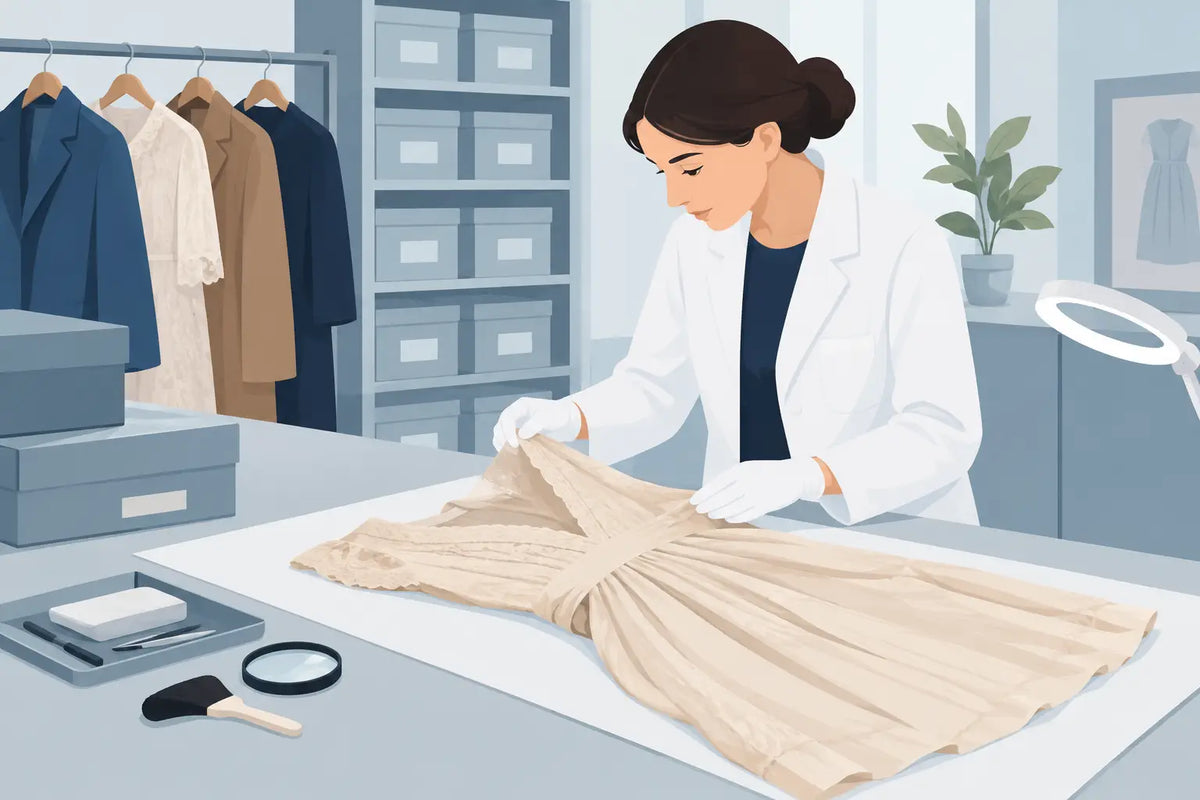
Storage is an extension of collecting. Keep pieces away from direct light, avoid overloading hangers, and use breathable protection rather than sealed plastic. Heavy knits and fragile stretch garments are often safer folded with acid-free tissue. Photograph each acquisition, record measurements and condition, and retain any supporting material. The record becomes more valuable as the collection grows.
For one-of-one garments, physical examination remains irreplaceable. At Anastasia Boutique, The Window is considered in person, by appointment, because certain objects ask for time: the fall of a coat, the internal anatomy of a jacket, the exact shade a photograph cannot hold.
Choose your world carefully. The right 1990s garment should not feel like a costume from a finished decade. It should continue to complicate the present each time you wear it, handle it, or see it differently in the light.

Leave a comment
This site is protected by hCaptcha and the hCaptcha Privacy Policy and Terms of Service apply.