
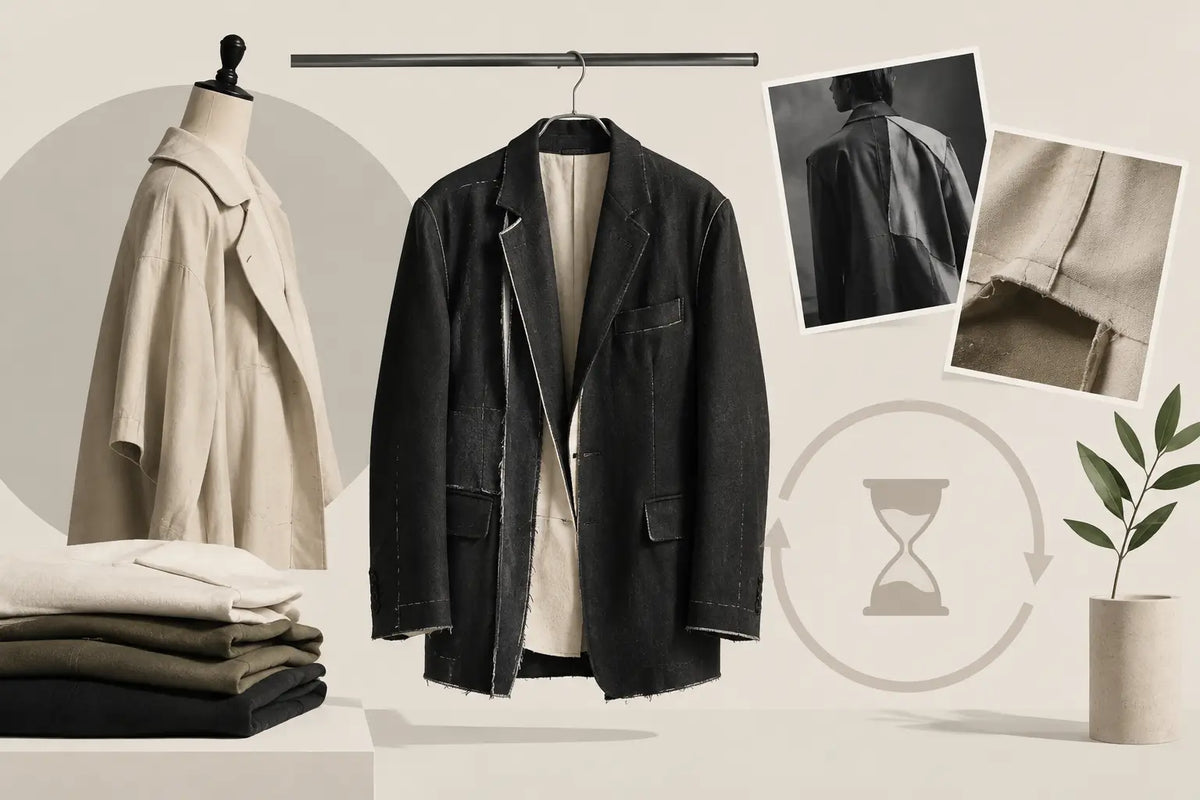
Why Maison Martin Margiela Archive Clothing Lasts
A Maison Martin Margiela archive clothing piece is rarely only a garment. It may be a deconstructed jacket whose lining has become its exterior, a knit reworked from found material, or a dress that asks the wearer to reconsider where a body begins and a silhouette ends. The most resonant examples still feel slightly unresolved. That tension is precisely why they continue to matter.
For collectors, the appeal is not nostalgia for the 1990s or early 2000s alone. It is access to a design vocabulary that changed the terms of modern fashion: anonymity over personality, process over polish, and garments that reveal rather than conceal their construction. Margiela did not simply create recognizable pieces. The house made the act of looking more rigorous.
What Defines Maison Martin Margiela Archive Clothing
The name Maison Martin Margiela refers to the period when the house was founded around its original, elusive author. The label’s early work established ideas that later became widely imitated: exposed seam allowances, trompe l'oeil prints, oversized or reduced proportions, recycled components, unfinished hems, replica garments, and the four white stitches that fasten a blank label to the exterior.
None of these details should be treated as a shortcut to value. A visible stitch, by itself, does not make a piece significant. The distinction lies in the relationship between concept, construction, and season. A garment’s apparent irregularity may be an exact decision: a shoulder displaced to alter posture, a lining cut to function as a shell, a familiar object transformed through scale or material.
Early work is often admired for its directness. A painted boot, a reconstructed sweater, or a jacket with its internal architecture exposed can carry an idea without becoming costume. Later collections expanded the house language through tailoring, tailoring’s undoing, domestic references, historical silhouettes, and studies of anonymity. The best archive pieces remain wearable because the provocation is built into the cut, not applied as decoration.
The labels tell part of the story
Margiela labels can offer useful orientation, especially the numbered line system associated with specific product categories and approaches. Yet labels should be read alongside the garment, never in isolation. Fonts, stitching, sizing tags, country-of-origin labels, fabric composition, hardware, and the finish of a seam all contribute to a credible reading.
The blank white label with four tacks is iconic, but it has also been copied extensively. Its presence is evidence to examine, not proof to accept. A serious archive evaluation considers whether every component belongs to the same object and period. Replacement buttons, altered hems, removed labels, and repaired linings do not automatically disqualify a piece. They do, however, change how it should be understood and priced.
Why Provenance Changes the Object
Archival fashion is often discussed in terms of rarity, but rarity without context can be hollow. Provenance gives a garment its contours. A dated runway reference, an original retail tag, an informed prior owner, editorial documentation, or a history of careful collection can clarify what an object is and why it survives.
This is especially relevant to Margiela because the house’s work has circulated through many interpretations. Some pieces were made in limited quantities. Others appeared in variations across markets or were altered through wear. A collector does not need a complete paper trail for every garment, but the more unusual the object, the more useful supporting detail becomes.
Condition requires the same disciplined eye. A hand-finished, intentionally distressed piece should not be judged by the standards of immaculate luxury ready-to-wear. At the same time, conceptual wear is different from damage. Fabric loss, brittle coatings, dry-cleaning residue, stretched knits, failing adhesives, and compromised leather deserve clear disclosure. The question is not whether a piece looks new. It is whether its condition remains faithful to its construction and future use.
How to Read Construction Before You Buy
Start with the silhouette in motion. Margiela’s strongest garments often alter the wearer’s relationship to proportion: sleeves shift the arm line, a jacket sits away from the body, a skirt creates volume where the eye does not expect it. Photographs can show surface, but an in-person viewing reveals weight, balance, and the quieter logic of a pattern.
Then look inside. Examine seam finishes, internal labels, pocket construction, linings, closures, and the transition between materials. In archive clothing, the interior is frequently where the design becomes most legible. A jacket that appears spare from the outside may contain a complex arrangement of darts, tapes, facings, or handwork that explains its shape.
Fabric matters as much as the label. Cotton may be treated to resemble paper. Wool may carry a deliberate irregularity. A synthetic surface may be chosen for its plasticity rather than its luxury. The house’s material intelligence often lives in these decisions. A piece can be visually dramatic and still be practical; another may require considered care and limited wear. Neither is inherently better. The right choice depends on whether you are building a wardrobe, a study collection, or both.
Fit is not a secondary concern
Margiela’s sizing is not always intuitive by contemporary standards. Oversized forms may be purposeful, while fitted pieces can rely on exact shoulder placement or a particular relationship between waist and hip. Altering a garment to force a conventional fit can erase the very quality that made it worth seeking.
Before committing, consider the original intention of the piece and the limits of its construction. A simple hem may be reversible. Recutting a shoulder, narrowing a sleeve, or removing intentional volume is another matter. Collectible clothing should be lived with, but it should also be protected from irreversible correction.
The Difference Between Iconic and Personal
Some Margiela pieces arrive with immediate recognition: tabi footwear, replica references, stockman-inspired forms, painted surfaces, and garments that turn conventional tailoring inside out. These are important entry points, particularly when they are well preserved and correctly identified.
But an archive with real staying power is not built from recognizable symbols alone. Often, the most compelling acquisition is a quieter coat with an unusual internal finish, a knit whose composition feels distinctly of its collection, or a modest top that carries the house’s precision without announcing itself. These pieces can become more personal over time because they leave room for the wearer.
The market has made certain references highly visible, which can create a temptation to buy only what is already validated. There is value in studying the adjacent work: less-photographed ready-to-wear, transitional seasons, and garments whose significance appears through handling rather than social recognition. Knowledge is useful here, but attention is better.
A Considered Place in a Larger Archive
Margiela becomes even more revealing when placed beside other experimental houses. The tension with Rei Kawakubo’s formal abstraction, the dialogue with Yohji Yamamoto’s drape, or the shared rigor of early Raf Simons can sharpen one’s eye. These are not interchangeable designers. Their garments ask different questions of the body, history, and desire.
For a collector, that distinction can guide acquisition. A Margiela garment may serve as the conceptual hinge in an archive that also includes radical tailoring, altered streetwear, or sculptural knitwear. It does not need to be worn as a complete look from one label. Often it is stronger when allowed to retain its own logic.
At Anastasia Boutique, the separation between Now and Then makes room for this kind of looking. Current work can be understood in relation to the garments that challenged the field before it. For singular objects, The Window is best experienced in person, where fabrication, scale, and condition can be read without mediation.
A lasting Margiela acquisition should reward a second look, then a third. Choose the piece whose construction keeps revealing itself in the hand and whose strange, exact proposition still feels alive when you put it on.



Leave a comment
This site is protected by hCaptcha and the hCaptcha Privacy Policy and Terms of Service apply.