
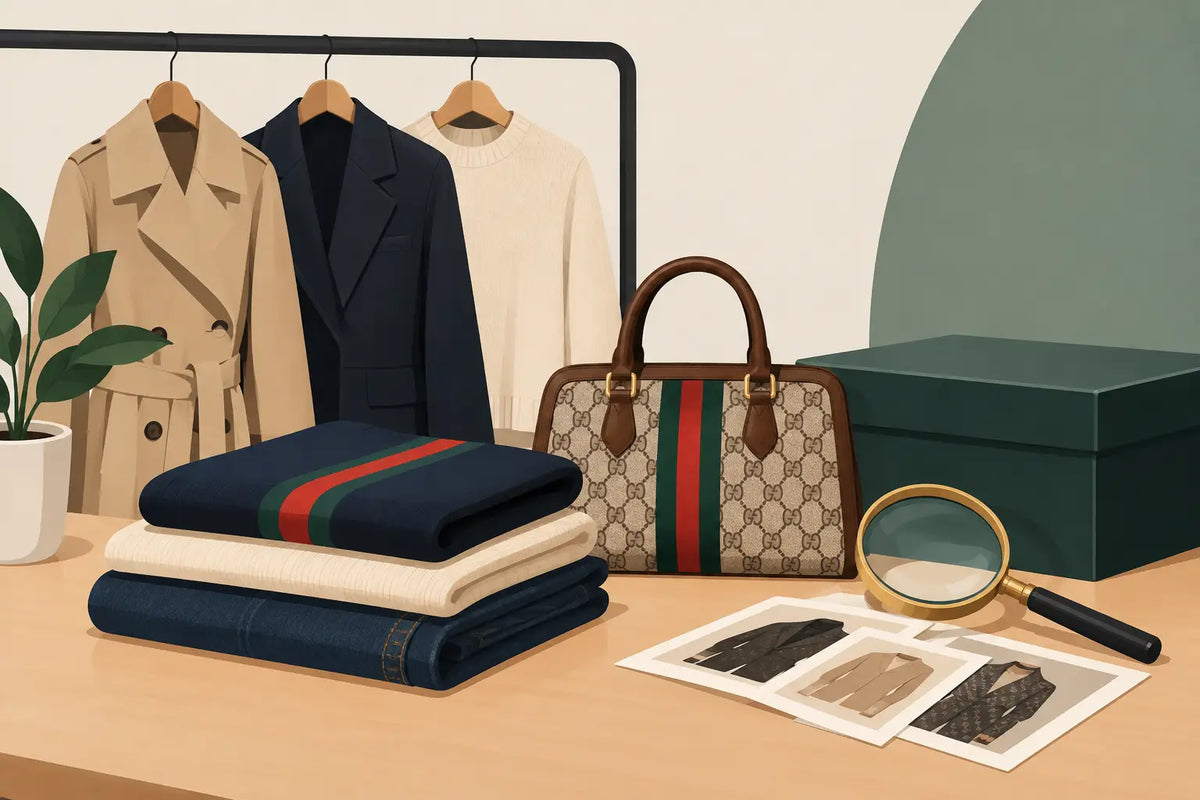
Authentic Designer Archive Clothing, Examined
A 1998 Comme des Garçons jacket can be worth pursuing because its asymmetry still feels unresolved. A late-1990s Margiela garment may reveal its origin in the line of a shoulder, the weight of a cotton label, or a construction choice that was never intended to be decorative. Authentic designer archive clothing is not merely old luxury. It is design with a specific place in a house’s language, made at a particular moment and carried forward with its evidence intact.
That distinction has become harder to hold as the word archive is applied to almost any discontinued designer item. Scarcity alone is not significance, and a recognizable logo does not establish provenance. For collectors, stylists, and those who wear fashion as a form of authorship, the question is more exacting: does this piece belong to the history it claims?
What Makes Designer Archive Clothing Authentic?
Authenticity begins with attribution, but it does not end there. A garment should correspond to a designer, line, period, and construction vocabulary in a way that makes sense. Its labels, hardware, fabric, pattern, finish, and condition should support one another rather than tell competing stories.
A Yohji Yamamoto coat from the 1990s, for example, may use a dense wool with a soft, collapsed drape and an apparent informality that is carefully engineered. A Rick Owens leather piece has its own logic: proportion, hide selection, hardware, and a tension between protection and exposure. Gaultier mesh from the era of the body prints asks for different scrutiny again, including print clarity, stretch recovery, and the precision of the garment’s seams.
The strongest archive pieces communicate before a label is read. That is not mystique. It is the accumulated consistency of a designer whose ideas reached the garment level.
Originality Is More Than a Correct Label
Labels matter, particularly when they establish a production era or a secondary line. Yet labels are also the most easily copied element of a garment. They must be considered alongside internal care tags, fiber content, country of production, zipper pulls, button backs, stitch density, and the way a garment has been cut.
An authentic piece can also have variations. Production changed across markets, factories, and seasons. Some early garments were made in limited quantities and do not conform neatly to later systems of tagging. A missing care label is not automatic disqualification, especially in a garment that has been worn for decades. It simply raises the standard for every other point of verification.
The opposite is equally true: pristine labels cannot rescue construction that is wrong for the purported designer or year. Good authentication is cumulative. It weighs many credible details rather than relying on one supposedly decisive sign.
Reading the Garment Before the Story
The archive market often begins with an appealing caption: runway season, rare color, celebrity provenance, museum-worthy. Those details may be useful, but the garment should withstand inspection without them.
Start with its silhouette. Is the proportion consistent with the relevant period? Junya Watanabe’s engineered panels, Undercover’s subcultural references, and Maison Martin Margiela’s deconstruction are distinct visual systems. They can overlap in mood, but their decisions are not interchangeable. A seller’s description should never be doing all the work.
Then look inside. Finished seams, lining behavior, dart placement, hem allowance, and evidence of handwork can reveal more than exterior photographs. Avant-garde design is not synonymous with roughness. A deliberately exposed edge may coexist with painstaking interior engineering. A seemingly simple black coat may contain the more difficult construction.
Fabric deserves the same attention. Age changes textiles, especially coated cotton, polyurethane, bonded fabrics, silk jersey, and early stretch blends. A material may crack, delaminate, fade, or lose elasticity even when the garment has been stored carefully. This is not necessarily a reason to avoid it. It is a reason to understand what ownership will require.
Provenance Is a Chain, Not a Mood
The word provenance is sometimes used as shorthand for a good story. In practice, it is a chain of information about where a piece came from and how it has been handled. The chain can be long or short, but it should be coherent.
A first-owner garment with original purchase documentation offers one kind of confidence. A piece acquired through an established collector, a respected wardrobe archive, or a long-standing boutique may offer another. Historical photographs, show references, old catalog images, and period editorial can support attribution, though they do not guarantee that a particular garment is genuine.
For collectible clothing, provenance also includes condition history. Has the garment been altered? Repaired? Professionally cleaned? Relined? A skillful repair may preserve a piece that would otherwise be unwearable. An undisclosed alteration, however, can change both fit and collector value. Neither untouched nor restored is always better. It depends on the designer, material, intended use, and rarity of the original.
When assessing authentic designer archive clothing, ask for direct clarity on what is known, what is inferred, and what remains uncertain. Precision is more valuable than theatrical certainty.
Condition Is Part of the Design Record
Archive garments were made to be worn, and many were worn intensely. A small repair, a softened leather cuff, or a faint mark inside a lining may be entirely acceptable in a rare piece. Still, condition should be described in material terms, not softened into vague language.
Natural fibers can often be stabilized, cleaned, or repaired with restraint. Synthetic materials introduce different risks. A deteriorating coated surface or crumbling foam-backed fabric may be irreversible. Rubberized finishes, glued constructions, and certain experimental textiles can have limited longevity regardless of price or careful storage.
This is where collecting and dressing diverge. A collector may accept fragility because the object is historically scarce. Someone seeking a garment for frequent wear may choose a later piece in stronger condition, even if it is less elusive. Neither approach is lesser. They simply produce different wardrobes.
Fit also deserves a clear-eyed view. Vintage sizing is inconsistent, and experimental tailoring can appear wrong on a hanger before becoming precise on the body. Measurements are essential, but so is an understanding of intended ease, shoulder placement, rise, sleeve pitch, and fabric behavior. The most persuasive archive acquisition is often the one that still creates a living silhouette rather than remaining permanently stored.
Why the Edit Matters
The archive market rewards speed, but speed produces noise. A compelling edit makes room for context: why this collection, why this version, why now. It sets a 2000s runway-era piece beside its design lineage rather than reducing it to a passing visual reference.
At Anastasia Boutique, the distinction between Now and Then recognizes that fashion history is not separate from present-tense dressing. A current-season garment can sharpen the reading of an earlier one. A single rare object can change the proportions, references, and expectations of everything around it.
Curation also means refusal. Not every recognizable item belongs in an archive. Some pieces are commercially familiar but historically slight. Others are quiet, difficult, and essential. The latter may not announce themselves immediately. They reward a slower eye.
When an In-Person Viewing Is Worth It
Photographs are useful for initial consideration, but some pieces should be seen directly before a decision is made. This is especially true for garments with complex fabric surfaces, unusual drape, aging technical materials, or highly individual fit. Color can shift under artificial light. A distressed finish can look like damage online, while real damage can be hidden by careful styling.
An in-person viewing allows the wearer to assess weight, movement, odor, texture, repairs, and scale. It also makes it possible to inspect the interior without haste and to understand whether a garment’s condition matches its purpose. For singular pieces, that exchange is part of the value.
The most enduring archive purchases are not made from fear of missing out. They are chosen because the garment remains convincing under close attention: its idea is intact, its material reality is understood, and its next life has a reason to begin.

Leave a comment
This site is protected by hCaptcha and the hCaptcha Privacy Policy and Terms of Service apply.