
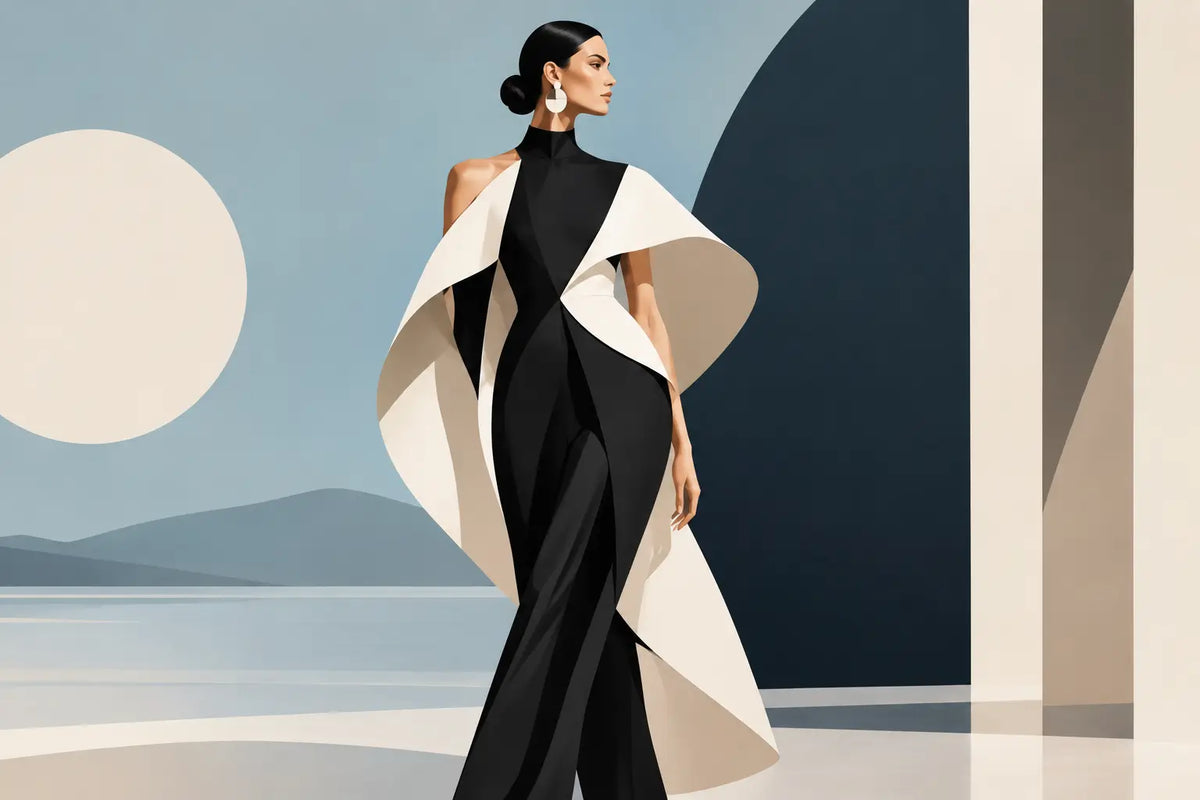
Avant Garde Designer Fashion Beyond the Season
A jacket can refuse the expected line of a shoulder. A knit can carry the trace of its own construction. A dress can alter the way a body occupies a room. Avant garde designer fashion begins there: not with novelty for its own sake, but with a distinct proposition about form, function, and identity.
For the person who already knows the difference, these garments are not simply alternatives to conventional luxury. They are records of a designer's vocabulary. A Martin Margiela deconstruction, a Rick Owens proportion, a Comme des Garçons volume, or a Yohji Yamamoto drape can be read almost immediately. The best pieces continue to reveal themselves with wear.
What Makes Avant Garde Designer Fashion Endure
Avant-garde fashion is often reduced to the dramatic image: the distorted silhouette, the unconventional fabrication, the runway piece that seems to resist ordinary life. That image has its place, but it is incomplete. The work that lasts is usually more exacting than spectacular. Its tension lies in cut, weight, finish, and the decision to make a familiar garment feel newly considered.
A black coat may appear restrained until its pattern is examined. A bias seam shifts the line of the body. An offset closure changes its posture. A deliberately unfinished edge makes the hand aware of the textile. These are not decorative gestures. They are structural choices, and structure is where a garment's intelligence resides.
This is also why the category cannot be defined by a single look. Avant-garde design may be severe, romantic, damaged, tailored, oversized, or nearly anonymous. Junya Watanabe can turn technical fabric into architecture. Jean Paul Gaultier can make the body a site of historic reference and provocation. Undercover can place unease beside tenderness. The common ground is a refusal to accept clothing as a neutral surface.
The Garment as an Object of Design History
Fashion moves quickly, but certain collections do not disappear when the season changes. They gain clarity. Distance allows a garment to be seen outside the styling of its original runway, press cycle, or retail moment. What remains is the idea, the construction, and the cultural position it held.
This is the particular charge of archive fashion from the 1990s and 2000s. The period produced garments that challenged luxury's conventions from several directions at once. Deconstruction questioned finish. Experimental tailoring reconsidered gendered form. Street references entered rarefied spaces without losing their friction. Technical textiles became conceptual materials rather than mere performance tools.
Provenance matters here, though it should never substitute for discernment. A documented piece from a significant collection has a different place in a wardrobe and in a collection than a later imitation of its language. Original labels, era-specific fabrication, condition, and a garment's relationship to a designer's wider body of work all shape its relevance. Rarity alone is not enough. A scarce item without formal conviction is still only scarce.
The most compelling archival pieces have presence without requiring explanation. They can be worn quietly with familiar clothes or placed at the center of an entire look. That flexibility is often overlooked by those who see experimental fashion only as costume. A strong archive garment does not demand a theatrical life. It changes the temperature of what is already there.
Now and Then, Worn Together
A considered wardrobe does not have to choose between current season and archive. The two worlds sharpen one another. A new Rick Owens knit can bring a contemporary severity to an older Gaultier skirt. A Yohji Yamamoto jacket from one era can make a current technical trouser feel less predictable. The point is not to reproduce a runway image from a particular year. It is to build a personal language across time.
There is a trade-off. Current collections offer immediate access to a house's present concerns: new proportions, materials, and developments in technique. Archive pieces bring specificity, historical context, and, at times, an irreproducible detail. One is not inherently more valuable than the other. It depends on whether the wearer is looking for an active chapter in a designer's work or a precise artifact from an earlier one.
For collectors, condition may be decisive. For stylists, a garment's visual force can outweigh minor signs of age. For someone building a wardrobe rather than an archive, comfort, alteration potential, and repeat wear deserve equal attention. A piece can be culturally significant and still not belong in your life. The right acquisition is the one that keeps returning to the body.
How to Read an Experimental Garment
Before looking at a label, look at the silhouette from a distance. Does the garment change the body's proportion? Does it create volume, compression, extension, or concealment? Then move closer. Notice where the seams sit, how the fabric falls, and whether closures are exposed, displaced, or obscured.
Material should be read with the same care. Boiled wool, waxed cotton, bonded jersey, dense nylon, hand-finished leather, and distressed silk all carry different intentions. A fabric may have been chosen for its behavior rather than its immediate beauty. It might resist the body, hold air around it, absorb light, or become more expressive through wear.
Finally, consider repetition. The strongest designers return to certain forms across years, but never exactly. A recurring shoulder line, a familiar boot shape, a method of wrapping, or a particular approach to decay becomes part of a house vocabulary. Recognizing those returns gives a single garment more depth. It places the piece within a longer conversation rather than treating it as an isolated object.
Why Context Changes the Experience
Online access has made it easier to locate exceptional fashion, but not every garment should be encountered as a thumbnail. Scale, movement, textile density, and condition are difficult to fully understand at a distance. This is especially true of one-of-one pieces and complex archival construction.
At Anastasia Boutique, the distinction between Now and Then makes room for both discovery and context. The Window exists for garments that ask for a closer encounter: rare pieces viewed by appointment at 460 Ocean Avenue, where fit, fabrication, and provenance can be considered without hurry. For a collector or stylist, that kind of access is not ceremonial. It is practical. It allows the garment to be understood on its own terms.
Avant-garde fashion also benefits from restraint in presentation. A rare jacket does not need to be overstyled to prove its importance. Often the most revealing test is simple: wear it with a plain trouser, a worn boot, or a familiar shirt, then notice what changes. If the piece holds its own without visual noise, it has earned its place.
Choosing Pieces That Stay With You
The temptation with experimental fashion is to buy the most immediately legible statement. Sometimes that is exactly right. A collector may seek the iconic runway object, while a stylist may need the garment that carries an image in a single frame. But private wardrobes often grow more interesting through pieces that become clearer over time.
Look for the garment whose construction you want to revisit. Consider whether its material will age with character and whether its proportions offer more than one way to wear it. Ask whether you are responding to the designer's idea or merely to its recognizability. These questions do not make the choice clinical. They make it more personal.
Choose the piece that gives you a new silhouette without taking you out of yourself. Wear it often enough for its meaning to move from the hanger into your life.

Leave a comment
This site is protected by hCaptcha and the hCaptcha Privacy Policy and Terms of Service apply.