
Why Are Runway Samples Valuable to Collectors?
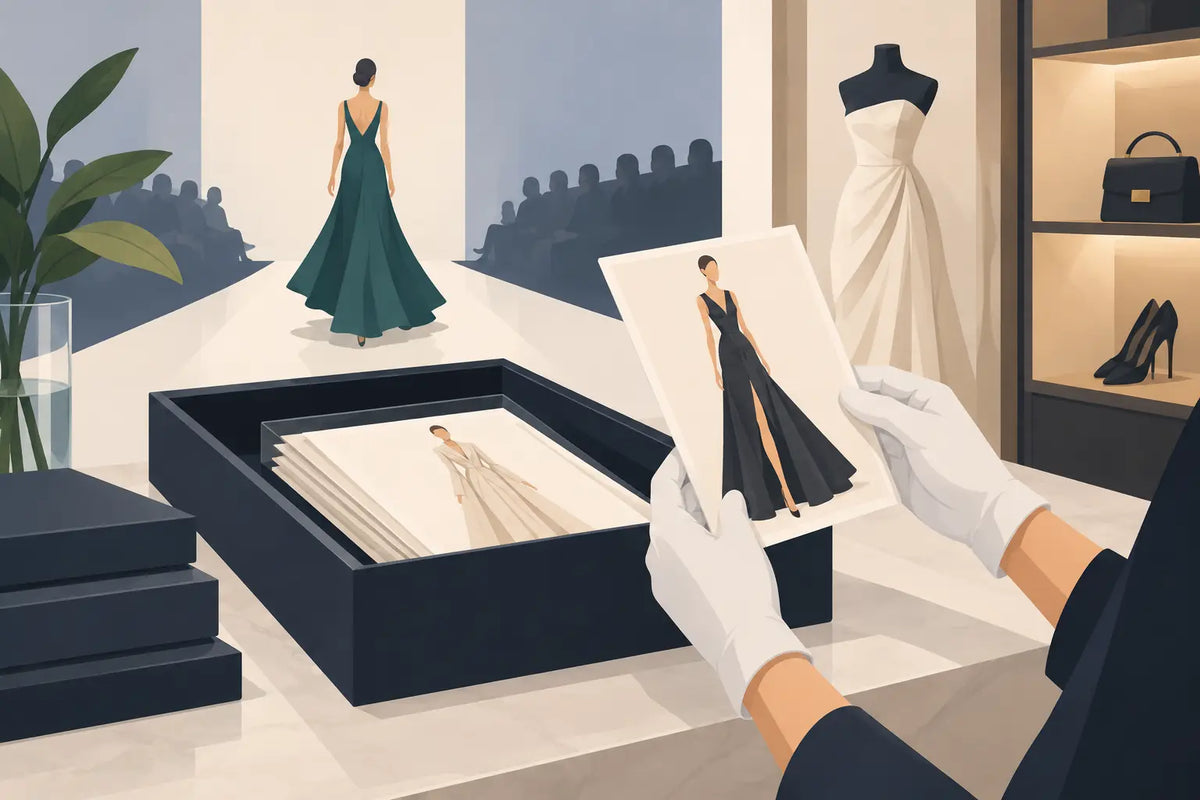
A runway sample is not simply a garment that appeared before the cameras. It is evidence of a designer’s decision at a particular moment: a silhouette resolved for the body, a fabrication selected for movement, an idea made visible under show lighting. For collectors asking why are runway samples valuable, the answer begins there. These pieces can hold a closer relationship to a collection’s original proposition than the versions later made for stores.
For houses built on construction, disruption, and visual language, that relationship matters. A runway sample may preserve the first cut of a Rick Owens jacket, the exact layering of a Comme des Garçons look, or the particular tension between tailoring and anonymity that defines Maison Martin Margiela. It is fashion as object, but also fashion as record.
A runway sample exists before the market does
Most runway garments are produced during the most concentrated period of a collection’s development. Designers, pattern cutters, ateliers, stylists, and image-makers are working toward a single presentation. The garment must communicate immediately, from a distance, and in sequence with every other look.
That urgency often produces details that do not survive into production. A closure may be changed for durability. A difficult textile may be replaced. A hand-finished element may be simplified, or a proportion adjusted to accommodate a broader size range. The store version can still be exceptional, but the runway sample may retain a more uncompromised expression of the original idea.
This is especially compelling in avant-garde fashion, where a collection is often structured as an argument rather than a group of isolated products. A Junya Watanabe engineered textile, a Yohji Yamamoto asymmetry, or an Undercover graphic may carry its fullest meaning within the specific season and runway context for which it was created.
Why runway samples are valuable beyond scarcity
Scarcity is real, but it is not the whole story. A sample can be rare because only one was made, because it was used in a fitting or presentation, or because it never entered commercial production. Yet rarity without design significance, condition, or credible history does not automatically create collector value.
The strongest runway samples unite several forms of importance. They are visually legible within a designer’s body of work. They reveal unusual construction or materials. They can be connected to a documented collection, show, campaign, or editorial appearance. And they remain sufficiently intact to allow the original design to be understood.
A sample’s irregularities can also be part of its appeal. An unfinished hem, an internal notation, a shifted label placement, or evidence of handwork can show the garment’s proximity to the atelier. These are not always flaws. In the right context, they are traces of process.
There is a distinction to protect, however. Not every garment marked sample was worn on a runway, and not every runway look is a one-of-one piece. Samples may have been made for showroom appointments, press pulls, fittings, or production development. Serious collecting asks for specificity. What was the piece made for? Which season does it belong to? Does its construction correspond to the presented look? Is there a clear chain of ownership?
Construction can reveal what retail cannot
Production garments are designed to be repeated. Runway samples are often designed first to be seen. This can make their construction unusually direct, elaborate, or even impractical in a way that feels essential to the collection.
Consider the difference between a commercially produced knit and an early runway knit with a hand-altered surface, unconventional gauge, or intentionally unstable edge. The latter may ask more of its owner. It may require careful storage, infrequent wear, and a knowledgeable conservator when repairs are needed. Its value is not based on ease. It rests in the fact that the garment holds a particular design gesture that would be difficult to reproduce faithfully.
The same is true of proportion. Runway samples are frequently made in one presentation size, sometimes altered for a specific model. Sleeves can be longer, waists more exacting, and hemlines more severe than their retail counterparts. For a collector, this is a trade-off rather than a defect. The piece may not behave like everyday clothing, but it can possess a visual authority unavailable in a standard run.
Provenance is part of the garment
In archival fashion, provenance gives a garment its coordinates. A dated runway image, a look number, an original press tag, or documentation from a trusted source can locate a sample within design history. The more unusual the piece, the more this context matters.
Provenance does not need to be theatrical to be meaningful. A credible account of acquisition, a period-correct label, and construction consistent with the season can be enough to establish confidence. Conversely, a dramatic story without material evidence should invite restraint.
Collectors should look closely at labels, internal finishes, size markings, and any signs of alteration. They should compare details with documented runway imagery while allowing for the fact that samples can differ from photographs. Lighting obscures fabric. Styling can conceal closures. A look may have been adjusted after the show. Authentication is rarely about one definitive feature. It is a reading of the whole object.
At Anastasia Boutique, the distinction between Now and Then makes this kind of looking more natural. Current work can be understood alongside the historical garments that shaped its vocabulary. A runway sample does not become valuable because it is old. It becomes compelling when its place in that continuum is clear.
The value of a sample depends on what you collect
For some collectors, the ideal runway sample is museum-like: important, fragile, and best preserved with minimal intervention. For others, value lies in wearing the piece with precision, accepting that ownership is a form of continued life. Neither approach is inherently superior, but each calls for different buying decisions.
If you intend to wear a sample, examine stress points before purchase. Check underarms, crotch seams, leather edges, coated surfaces, and areas affected by weight or friction. Ask whether alterations have already changed the original line. A garment can be wearable and collectible, but the most desirable samples are not always the easiest to live with.
If you collect primarily for study, prioritize integrity and documentation. The original belt, hardware, runway-specific accessory, or accompanying archive material may be as significant as the garment itself. Keep pieces away from prolonged sunlight, crowded hanging, plastic dry-cleaning bags, and uncontrolled humidity. Delicate knits and heavily embellished garments often benefit from archival storage rather than routine hanging.
There is also an emotional dimension that should not be dismissed. A runway sample can represent the first time a designer articulated an idea that later became central to their practice. It may be the look remembered from a formative collection, or an object that makes a familiar season newly strange. That recognition is personal, but it is not superficial. It is part of why fashion collecting has cultural weight.
When a runway sample is not the right choice
A runway sample is not automatically the best expression of a collection. Sometimes the final production version is more refined, more durable, or more complete. A retail garment may also offer a better fit, clearer sizing, and a version of the design meant to endure actual use.
The most compelling acquisition is not always the rarest one. It is the piece whose condition, provenance, construction, and relevance align with the way you collect. A modest production garment from an important season can be more satisfying than a compromised sample with uncertain history.
The question is not simply whether a garment walked a runway. Ask what it preserves: a material experiment, a vanished proportion, an early design decision, or the exact image that defined a collection. When those elements remain intact, a runway sample offers more than exclusivity. It gives its owner a direct encounter with fashion at the moment it became history.


Leave a comment
This site is protected by hCaptcha and the hCaptcha Privacy Policy and Terms of Service apply.