
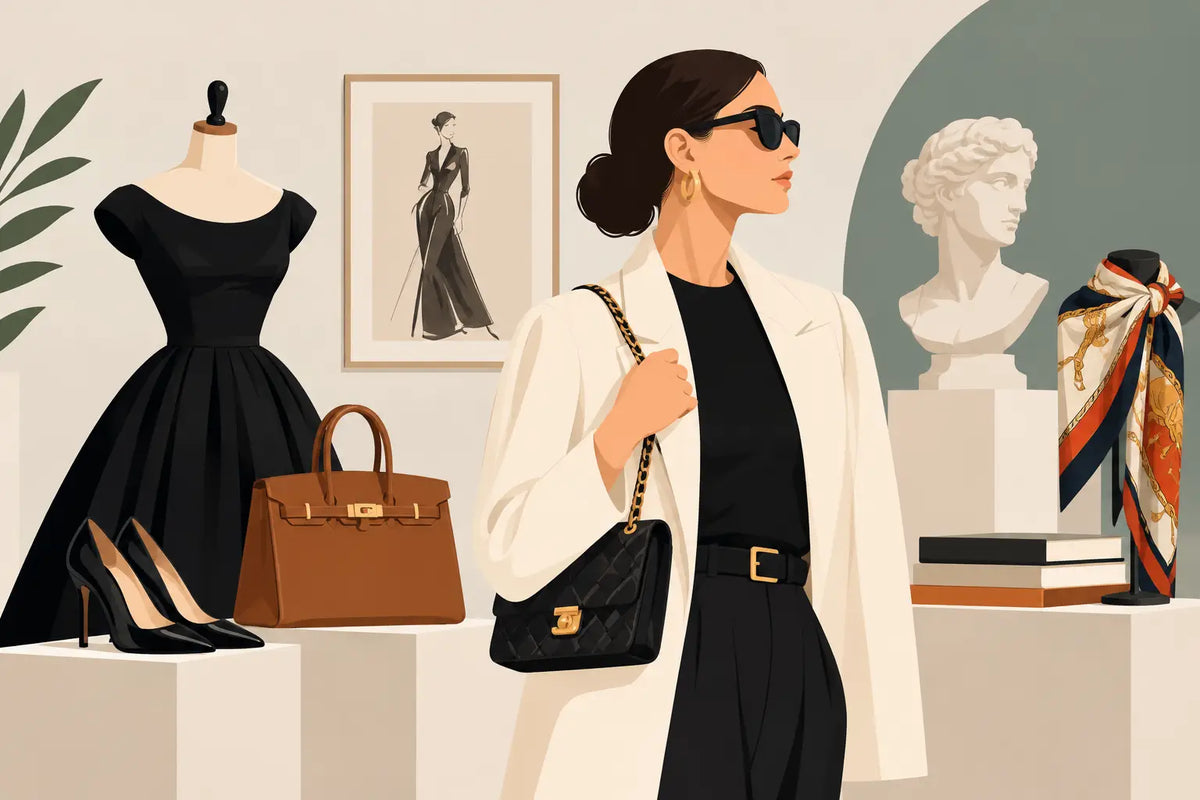
Collectible Fashion Is Design History You Can Wear
A Maison Martin Margiela Artisanal jacket with its interior logic exposed. A Yohji Yamamoto coat whose volume changes the pace of a room. A Jean Paul Gaultier mesh printed with an image that feels as current as it did decades ago. Collectible fashion begins where a garment exceeds its original season. It carries an idea, a hand, a record of how design moved forward.
This is not simply vintage shopping with a higher price point. It is the practice of recognizing clothing as material culture: objects shaped by radical construction, limited production, cultural context, and the particular condition in which they have survived. Some pieces were always rare. Others became rare because their relevance sharpened with time.
What Makes Collectible Fashion?
A collectible garment does not need a famous logo to matter. In fact, the most significant pieces often resist immediate recognition. Their value may sit in an altered shoulder line, a pattern cut on the bias, a technical fabrication, an unusual dye process, or a silhouette that changed the language of its era.
Design authorship is the first consideration. The work of Rei Kawakubo, Martin Margiela, Rick Owens, Yohji Yamamoto, Junya Watanabe, and Jun Takahashi holds collector attention because each designer established a distinct vocabulary. Their garments are not interchangeable expressions of luxury. A Comme des Garçons piece can make absence and distortion feel intentional. A Rick Owens leather jacket can be both armor and second skin. An Undercover graphic can hold a precise subcultural reference without becoming costume.
The particular collection matters, too. A look from a pivotal runway season, an early expression of a now-recognizable code, or a difficult-to-find variation may carry more weight than a more obvious piece from the same label. Collectors often look for the moment a designer introduced an idea, then trace how it evolved.
Material and construction provide another measure. Examine the cloth before the label. Is the wool unusually dense or washed to a specific irregularity? Does the garment rely on bonded seams, hand finishing, deconstruction, intricate knit engineering, or a textile developed for one collection? These details are not decorative footnotes. They are often the reason an object remains compelling when its original context has passed.
Collectible Fashion Is Not a Formula
Scarcity alone is not significance. A garment may be difficult to find because few were made, but it may also be difficult to find because it was not widely kept. Neither condition automatically makes it essential. The strongest archive pieces align rarity with design clarity, condition, and provenance.
Provenance can be formal or intimate. A documented runway sample, an identifiable editorial piece, or an item with a known original owner may offer a direct historical thread. Yet provenance also comes through close reading: a correct season label, period-specific hardware, original fabrication, or details consistent with an established collection. This is where a practiced eye matters.
Condition requires judgment rather than rigid perfection. A fragile 1990s mesh top, a faded graphic, or naturally softened leather may retain its integrity precisely because it shows age honestly. Structural damage is different. Missing closures, compromised textiles, dry rot, aggressive alterations, and poorly considered repairs can alter both wearability and meaning.
It depends on the garment's purpose. A museum-level piece may be collected for preservation, while a beautifully worn Yohji coat may be bought to become part of a daily uniform. The former asks for conservation. The latter asks for care, rotation, and an understanding that the life of the object continues with its wearer.
How to Read an Archive Garment
Begin with the silhouette. Put the garment on a body, if possible, and notice what it asks of posture and movement. Avant-garde fashion is often understood incorrectly on a hanger. A seemingly severe Margiela dress may reveal a precise relationship between lining and drape when worn. A Junya Watanabe piece may make sense only once its engineered panels move together.
Then study its internal life. Linings, seam allowances, closures, labels, pocket construction, and hems often reveal more than the exterior. Authenticity is not a single detail or a quick online comparison. It is a constellation of details that agree with one another.
Context completes the reading. Ask what was happening in the designer's work at that time. Was the collection responding to tailoring, industrial design, punk, romance, military dress, technology, or the history of the fashion system itself? A garment gains dimension when it is seen as part of a larger argument.
This does not mean every acquisition requires academic distance. Feeling matters. The piece should still create a charge: a sense that its proportion, surface, or conceptual tension has not been exhausted. Collecting without that response can become inventory rather than a personal archive.
Now and Then Belong Together
The most interesting wardrobes are rarely built from one decade. Current collections and archival pieces can sharpen one another. A new Rick Owens knit may bring a 2000s leather piece into focus. A contemporary Comme des Garçons skirt can change the reading of an earlier jacket. The point is not to recreate a runway look exactly, unless that is the pleasure of it. It is to create a private continuity across time.
This is why collecting differs from costume. Costume fixes a garment in the past. A considered wardrobe lets it speak in the present. The wearer should not disappear beneath the historical importance of the piece. Instead, the garment and wearer should establish a new relationship.
For some, that means a single archival object worn with restraint: a Gaultier mesh under a plain black jacket, an early Margiela accessory with otherwise quiet tailoring. For others, it means tension between worlds: technical nylon against aged wool, extreme proportion beside clean denim, a conceptual garment styled with almost no explanation.
There is no need to acquire quickly. The strongest collections tend to be edited over years, with room for hesitation. A compelling piece that does not fit your life is not necessarily the right piece. Conversely, an object you return to repeatedly may be worth pursuing even if it refuses easy styling.
The Value of a Trusted Edit
The archive market rewards knowledge, but it also contains ambiguity. Labels change. Sizes shift. Online images flatten color and texture. A piece can be described as rare without being well understood. The difference between access and curation is the ability to place an object accurately: designer, era, fabrication, condition, and relevance.
At Anastasia Boutique, the distinction between Now and Then makes that conversation tangible. Current-season design sits beside archival work from the 1990s and 2000s, allowing collectors to see lineage rather than isolated product. Certain one-of-one pieces remain Only at the boutique, through an appointment at The Window in Laguna Beach, where handling, fit, and material can be considered without haste.
That physical encounter matters. Weight, scent, sound, and movement are part of a garment's evidence. The slight crackle of treated cotton, the density of a boiled wool, the way aged leather warms at the elbow: none of this translates fully through a screen.
Collect for the Life of the Piece
Care is part of ownership. Keep archival textiles away from prolonged sunlight, avoid crowded storage, and give weighted garments proper support. Clean only when necessary, and seek specialists who understand delicate fabrics, embellishment, leather, and complex construction. Retain any original tags, receipts, garment bags, or collection information. They become part of the object's record.
More importantly, let the collection remain specific to you. Buy the piece that has a reason to stay, whether it is a threshold garment from a designer's career, an exceptional study in construction, or simply the coat that changes how you enter a room. Fashion becomes collectible when time cannot reduce its point of view.


Leave a comment
This site is protected by hCaptcha and the hCaptcha Privacy Policy and Terms of Service apply.